KRUGERSDORP CAMERA CLUB

Home


Fine Tuning Your Photography

The emergence of digital photography over the last few years has somehow changed the way we look at photography. I have seen everyone from amateur to pro showing a renewed excitement for photography. They are trying new techniques, experimenting and just plain having fun. Other folks I know are still taking a wait-and-see approach, preferring to stick with a tried-and-true formula that film has given them over the years.

It has become quite obvious to me that we all have our own opinions in the "digital versus film" controversy. Which one is best? I'm sure you've heard this comment: "it feels like you're cheating when you use digital." We could probably do an entire forum on the subject, but it would only be one more added to the many that are already out there.

Having been on both sides of the fence, shooting film for some twenty-five years and now shooting digital, I can sympathize with both film and digital shooters. A person emailed me the other day expressing interest in one of our workshops. He said he was interested, but we talk so much about digital, that he figured he might not be welcome with his film camera. Wow! I didn't mean to come across that way, but I guess my new found excitement could confuse folks into thinking that anyone not shooting digital should pack up and go home. Not at all!

One thing I have mentioned many times over the past few years is whether you shoot with an old Pentax K1000, a 4x5 view camera, or the latest digital SLR, you still need to exercise good technique. You still have to focus, you still need correct exposure, and you still need great light and good composition. After all, it's still photography, and my message to you is this:

It's time to get back to the subject of photography, to concentrate on doing what we love to do. I don't care what equipment or tools you use to do it, as long as you just do it!

With that said, let's look at the really important side of our photography, the work that goes into fine tuning your photography.

This is a "non-denominational" approach to good photography, putting aside our personal preferences of equipment and tools of the trade, to work on the more artistic and technical details that go into creating great photographs.

Well guess what? When it comes to fine tuning your photography the same "rules" still apply. Just because you're past that beginner stage or shooting digital instead of film doesn't mean you can leave your tripod home. It doesn't mean you can close your eyes and point the camera like a divining rod in the vicinity of your subject, and it will detect the perfect composition for you. It still involves some conscious effort.

Maybe you feel that you are somewhat beyond the novice level. You already know the importance of using a tripod, and exercising good technique. You may have reached a point where you are ready to take your photography to the next level. Sure every now and then you get that keeper shot that would make even David Muench jealous, but you lack consistency, wishing that you could do this every time you went out to photograph. Well, so do I, but while nothing will replace experience, a better understanding of how to fine tune your technical and artistic skills will make a big difference in how often that great photograph actually comes along.


David Muench

I'll show you my seven-step mental check list that I use every time I take a picture to get you thinking of different ways to look at any given potential photograph and to be able to determine what it will take to capture your own vision. While seeing the potential for a great photograph is one thing, exercising good technical skills each time will be just as important. "Fine Tuning Your Photography" is like practicing the basics without any mistakes. It's seeing great light and knowing what to do with it, or recognizing poor light and returning another day.

It can be frustrating to photograph a subject even under ideal circumstances, only to later discover your horizon line is tilted, a breeze blew the flowers slightly out of focus, you didn't notice the sun-flare on the lens, and it looks like there's a tree sticking directly out of the top of your friend's head. Other than fixing all of this in Photoshop, you're dead in the water!

You have to practice more than just 'looking' through the viewfinder: you need to begin 'seeing' before you press the shutter. You have to follow that mental checklist each and every time you take a picture. You may overlook one or more of those steps when you press the shutter, and only realize your mistakes later, but that's okay, it's not about perfection, it's about learning and improving your photography. I tell folks that I believe my best work is still out there waiting for me to capture it. After all, it would be very boring and uninspiring if we didn't have to work at it a little.

My Mental Check List for Fine Tuning Your Photography:

1. Become familiar with your equipment: If you're spending all your time trying to figure out how to take your camera off 'Program' so you can shoot a sunset, it may be dark before you finally figure it out. If you spend that precious moment asking someone else how to adjust your camera, you may both miss the shot. Whether digital or film, today's cameras have a lot of bells and whistles, a lot of custom programs, various metering methods etc. Become familiar with the bells and whistles. I know, I know, you may even have to read your manual.

2. Organize your tool box: Yes, I'm talking about your camera bag. Keep it organized putting everything in its proper place so that when you're in a hurry you don't find yourself frantically tearing through your stuff. You should be comfortable enough with the layout of the equipment in your bag to be able to find every lens, filter, roll of film, CF card, battery, etc. blindfolded. No, I'm not kidding.

3. Keep your equipment ready to use: Chances are you'll miss some great shots if you aren't ready for them. Did you wipe down your tripod or clean your lenses and filters the last time you shot? Remember how dusty it was that day! Are your batteries charged? Yesterday you were shooting landscapes, today you're shooting wildlife. Do you have the right lens on the camera? Is that a 24mm lens on the camera that's still set at f/22 using manual metering, manual focus, when you meant to put the 400mm on it, using auto-focus and shooting in Aperture Priority at f/4? Did you put film in the camera? Was that slow-speed Velvia that you had in your camera yesterday and do want a faster film like Provia in there today?

4. Pay attention to the details: Okay, you don't have any excuses, your equipment is ready. You're already using a good sturdy tripod and a cable release. You're no longer fumbling with your equipment; you're just ready to take some great pictures. I've found through the years that if there is any one area that really separates the pros from the rest of the pack, is that they have learned to pay attention to details.

One of the biggest advantages to using a tripod is the ability to slow down and more closely examine your composition. Look through the viewfinder making sure there are no distracting elements that will take away from the impact of your composition. Something as simple as a branch sticking into the picture can detract from the image. Take your eye away from the viewfinder and look around for any junk that shouldn't be there. I find this very valuable when using a wide angle lens. "Oops! I didn't even see that Coke bottle floating there in the bottom of my composition."

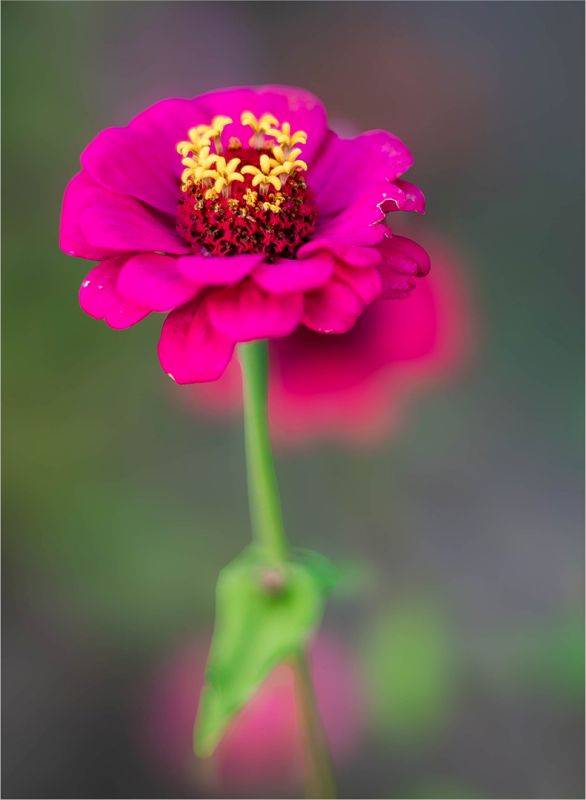
Ask yourself: is that the best foreground subject for this composition, or could I pick a better subject than the one I've chosen? In macro work for example, pick a flower with petals that aren't wilted. Maybe a bug has eaten a piece out of the leaf. If you're shooting wildlife, try to find the best subject possible, then, work that subject trying to get the best pose, looking for catch light in the eyes, with ears perked, etc.

5. Work your subject: If you think the pros get some of their great images on the very first try, think again. Sometimes I'll see the potential for a great shot, compose, meter, focus and shoot and wow, I got the shot. But more often than not, some of my best images come from working the subject. I'll try cropping in closer on the composition, or shooting from a lower angle. I'll shoot horizontal and then vertical. I'll try a wide angle lens and then maybe switch to a telephoto. Don't forget to try filters. I'll often use a warming polarizer and use a graduated neutral density filter for those difficult lighting situations. Too often we grab the first shot that presents itself. Try both horizontal and vertical compositions and try composing with different lenses. Sometimes the first shot will be the best, but you'll be surprised how many times you'll like the "experimental" compositions.

You may find that nothing looks quite as good as the first shot, or you may like several different compositions. Working your subject will not only increase the likelihood of creating a nice image, but you'll be challenging your creativity, keeping that creative eye sharp and focused.

6. Good Composition: When you take the extra effort to work your subject, keep in mind all that you've learned about good composition. Using the basic compositional elements of line, shape, texture and form will help you put together pleasing compositions that are simple, yet compelling.

Your images, when composed properly, will captivate the viewer giving them a pleasing photograph to look at.

7. Lighting: When going back over your own mental check list, lighting should top that list. I list it here at number seven because you still have to know what to do with that light when you are faced with it. So, for all the skills that you may possess as a photographer, if the lighting isn't great, chances are your image won't be either. To put it simply; lighting is everything! This is another area that the pros have learned so well. It is just as important to know when not to take a photograph as it is to know when. Potentially great shots will only be average if the light is average. You simply cannot force a great shot! First, you have to be there, and then you can begin working your subject using your own creative eye and your own good technique. Then, and only then, will you begin to get the results that you are looking for. Granted, there are times when the quality of light in front of you is the only light you're going to get on that particular outing.

These challenges are what make this kind of photography so special. It takes a well balanced photographer, one whose technical skills are evenly balanced by his or her esthetic or artistic skills. So, what do you do? My advice; practice tips 1-6 for fine tuning your photography, and when that magic light appears, you'll be ready!

Vivivlight – Gary Stanley

[home] [back]

Digital vs. film

New technologies can create incredible pictures, but do they compromise the art of photography?

I had the extreme pleasure this week of attending an exhibition of photography by Christopher Burkett, whose images of nature are so breathtaking in their luminosity, colour, and detail that many observers assume they are digitally enhanced. They are not; Burkett's photos are made on 8-inch by 10-inch colour transparencies or medium-format film, without lens filters, and are masterfully printed without digital enhancement of any kind.

Some people resist the idea that the beauty and colour captured by Burkett's camera actually exists in nature. Their skepticism says something important not just about our increasing alienation from nature, but also about our increasing acceptance of digital photography and digital image enhancement through software.

We know that amazing things can be done to tweak photographs: repairing flaws and blemishes, sharpening colours and contrast, even adding or subtracting subject matter to create an ideal image.

But our acceptance of new imaging technology comes at the cost of our trust in the relationship between eye and photo. How curious that, when confronted by photographic images of nature's exquisite beauty, many of us assume they can't possibly be, well, natural.

Burkett has a "no digital prints" symbol on his web site.

And that started me wondering: Does digital photography and image manipulation debase the true art of photography? Or is the digital camera a miraculous new tool that will allow photographers to achieve new levels of art?

Perhaps both.

And the question arose in my mind, if Ansel Adams - arguably the most accomplished and certainly the most popular nature photographer of the past century - were alive today, would he go digital?

"Far be it from me to speak on his behalf, but since I did have contact with him in earlier days, I know that he was a smart and aggressive guy," said Richard LoPinto, vice president for SLR camera systems at Nikon Inc. LoPinto has more than 30 years experience at Nikon, during which time he has seen digital cameras emerge and eventually overtake film cameras.

"He shot with a large-format camera and had the patience to stand around waiting for hours for the perfect shot, but he also used our Nikon FM series cameras," LoPinto continued. "I would like to speculate, and it's purely my personal opinion, that were he with us today he would be really taken by the technology and would be at the forefront."

"In fact," LoPinto said, "I would go so far as to say that if Rembrandt and Picasso and other great artists of the past were alive today, they would not be able to resist the idea of using digital technology. Think of Norman Rockwell. All of his art was based on photographs he made. Conversely, some of the great photographers of our time emulate the techniques of great artists," LoPinto said. "When I take portraits I like to use what you might call Rembrandt lighting, and a digital camera is a wonderful tool for experimentation."

"So, Ansel Adams, yeah, I think he'd love it,' LoPinto said.

And that leads to the hypothetical question, which Nikon digital camera would Ansel Adams use?

"Considering his typical tendency to use high-quality, large-format cameras and his desire that it be handy and convenient, I suspect he would be attracted to our D100, for its size and versatility and overall digital image quality."

But, I asked, is it really possible, with relatively affordable digital cameras, to take a digital image that equals the quality of film? And at what level, in terms of megapixels, does a digital camera equal the resolution of film?

"I recall from the early days of calculating an equivalency, it was thought that with 10 megapixels you would have a digital image that is competitive with a film image," LoPinto said. "But it was a long time ago when that speculation took place. Since then, digital technology has developed dramatically, and many of the artifacts that were associated with digital photography in those early days have gone away. The technology has changed so much."

"Today you'll find countless photographers who are using medium to medium-high resolution sensors, like the CCD in our D1X, that take a 6 megapixel image that can be interpolated up to 10 megapixels."

In other words, the image sensors in today's high-end digital cameras add information to the shot that the camera otherwise can't see. The actual pixel count is merely one factor in the overall quality of the camera. The optics, the metering, the various controls and the built-in software all are at least as important as the pixel count.

"I like to say that at the onset of digital photography, it was the megapixel battle. Now it's the megapixel scuffle," LoPinto said. "With new technology we can sharpen images dramatically without changing the spatial resolution of the chip."

Many of Christopher Burkett's photos are printed on paper measuring 30 inches by 40 inches or larger. With most digital cameras in the consumer range, say, 3 megapixels or lower, the camera can't capture enough information on its own to make a print that big. The image would not scale; there would not be enough pixels to fill the larger printing space, and the image would break up, or pixelate.

But as digital cameras and sensors improved, so too did computers and photo-editing software. A new category of scaling software emerged to allow giant prints with out digital artifacts. "Prints as large as 30x40 are well within the realm of today's high-performance SLR digital cameras," LoPinto said. "Making prints the size of 11 by 14, or 11 by 17, or 20 by 24, even 30 by 40, it's a piece of cake. To get there, however, requires an operator of considerable skill."

It also requires big bucks not just for the camera and lenses and large-format photo printers, but also for a powerful computer and special software. And it also requires great patience to learn and master the software.

Recently, an industry analyst who follows the digital camera market made the bold prediction that film camera sales would dwindle into insignificance by 2008. Digital cameras already outsell film cameras. Digital camera sales are growing by double- and even triple-digit percentages each year, while film camera sales are flat or declining. But will film cameras really disappear?

"I find it hard to believe that film will disappear," LoPinto said. "There is still a very, very large audience that just won't do that kind of stuff [digital imaging], and film continues to play important role where time is not a serious factor. I will say, however, that digital will continue to grow. As digital grows in advanced technology and versatility, and as price points fall, digital cameras will gather a bigger and bigger audience. Even the most staunch film users will eventually add digital to their shooting scenarios. Whether it's a compact digital camera or an SLR, it's going to happen."

Peter Lewis, Fortune Magazine

[home] [back]